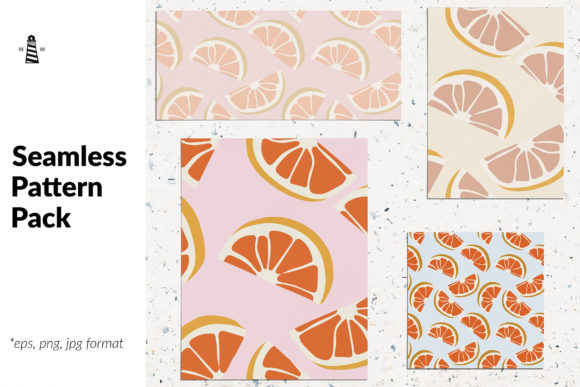
Grapefruit Slice Seamless Patterns: A Versatile Vector Resource for Creative Professionals
Seamless patterns rooted in natural motifs offer a timeless bridge between organic authenticity and digital precision—and among citrus-inspired design assets, Grapefruit Slice Seamless Patterns stand out for their vibrant tonal range, structural clarity, and exceptional adaptability. Unlike generic fruit motifs or stylized abstractions, these patterns are built from meticulously observed grapefruit cross-sections: each segment rendered with accurate curvature, membrane texture, seed placement, and subtle color gradients that mirror real botanical anatomy. The result is not just decorative repetition—it’s a scientifically informed, artistically refined vector system designed to scale, recolor, and recontextualize without visual compromise.
Why Grapefruit? Beyond Aesthetic Appeal
The choice of grapefruit as a foundational motif carries functional and perceptual advantages. Its bold, segmented geometry creates inherent rhythm and visual hierarchy—ideal for guiding the eye across large surfaces like wallpaper or fabric rolls. Compared to oranges or lemons, grapefruit slices offer greater contrast: deeper pinks and reds against pale yellow rinds, pronounced white pith networks, and irregular seed distribution that prevents mechanical monotony. This biological variation translates directly into pattern vitality—even at high magnification, no two repeats feel identical. Designers working on wellness branding, culinary packaging, or educational materials about nutrition often select grapefruit specifically because its color spectrum evokes freshness, vitamin C, and natural energy without leaning into cliché.
Technical Composition: What Makes These Patterns “Seamless”?
True seamlessness isn’t merely about edge alignment—it’s about optical continuity. Each of the 100 vector art compositions in this collection was constructed using non-destructive path-based workflows in Adobe Illustrator, ensuring mathematical precision at every tile boundary. The 8 EPS and 8 AI files include layered construction: base slice silhouettes, membrane outlines, rind textures, and optional seed clusters—all grouped logically and named descriptively. This architecture allows users to isolate elements—for instance, removing seeds for a minimalist version or enhancing pith lines for tactile depth in textile printing. Crucially, all tiles repeat flawlessly at any scale: whether tiled across a 48-inch-wide fabric bolt or shrunk to a 1-inch square for digital UI icons, the transitions remain invisible to the human eye.
Resolution Integrity Across Output Formats
The deliverables reflect real-world production needs. The 4 PNG files (12 × 12 inches, 300 dpi, transparent background) preserve alpha channels for immediate use in web banners, social media overlays, or layered mockups—no clipping masks required. Meanwhile, the 8 JPG images provide high-fidelity raster previews optimized for print proofing, client presentations, or CMS uploads where transparency isn’t needed. All raster assets retain full color fidelity in CMYK and RGB spaces, avoiding banding or dithering artifacts common in auto-converted files. Because the underlying vectors are resolution-independent, users can export custom sizes—say, a 36 × 72 inch mural or a 2 × 2 inch sticker sheet—without outsourcing to a retoucher or risking pixelation.
Practical Applications Across Industries
These Seamless patterns with citrus slices serve far more than ornamental roles. Their versatility emerges most clearly when mapped to specific professional workflows:
- Textile Design: Fashion and home décor studios integrate grapefruit motifs into seasonal collections—especially spring/summer lines emphasizing lightness and vitality. The segmented structure lends itself to jacquard weaves, where membrane lines translate into subtle raised textures, while rind tones anchor color palettes across coordinated pillow covers, napkins, and apparel.
- Wallpaper & Surface Design: Architects and interior designers specify these patterns for feature walls in healthcare waiting areas or boutique hotels, leveraging citrus associations with cleanliness and renewal. The seamless nature eliminates visible seams during installation, even on curved or vaulted surfaces.
- Digital Product Design: UI/UX teams apply scaled-down versions as subtle background textures in health-tracking apps, food delivery platforms, or nutrition education portals—adding visual interest without competing with interface elements.
- Packaging & Print Media: Beverage brands launching premium juice lines use the vectors to create cohesive label systems: one pattern wraps around a bottle, another adapts to a gift box lid, and a third serves as a foil-stamped detail on business cards—all derived from the same source file.
- Educational Resources: Biology teachers project enlarged slices to illustrate plant anatomy; curriculum developers embed them into printable worksheets about photosynthesis or nutrient absorption—transforming abstract concepts into tangible visuals.
Editing Flexibility: More Than Just Color Swaps
“Easy to edit” extends beyond changing fill colors. Because each vector file uses native Illustrator tools—global swatches, appearance attributes, and symbol libraries—users can modify multiple properties simultaneously. Adjusting saturation impacts only the flesh tones while preserving rind luminosity. Applying gradient meshes to individual segments simulates lighting direction for 3D-like depth. Even composition shifts are possible: duplicate a slice layer, rotate it 15 degrees, and offset its position to generate a dynamic “rotated repeat” variant—ideal for modern greeting cards or animated web backgrounds. For educators or hobbyists unfamiliar with advanced vector editing, the clean layer naming convention (“Rind_Border,” “Segment_Fill_01,” “Pith_Detail”) reduces the learning curve significantly.
Color Theory Considerations in Practice
Grapefruit’s natural palette offers rich opportunities for harmonious adaptation. The core set includes blush pinks, coral accents, ivory membranes, and warm amber rinds—but these aren’t locked to realism. Designers routinely shift hues to align with brand guidelines: converting pink segments to indigo for tech startups, deepening rind tones to charcoal for luxury skincare, or muting all colors to sepia for vintage apothecary themes. Importantly, the vector structure maintains relative contrast ratios through such changes, ensuring accessibility compliance (e.g., WCAG AA minimum contrast for text overlays). This level of control separates these resources from static JPEG patterns, where recoloring often degrades edge sharpness or introduces moiré effects.
User-Centric Design Decisions
Every aspect of this collection reflects direct input from practitioners. The decision to include both EPS and AI formats accommodates legacy studio pipelines (EPS for older RIP software) and modern collaborative workflows (AI for shared cloud libraries). Providing exactly four PNG variants—not three or five—ensures optimal balance between transparency utility and download efficiency. The consistent 12 × 12 inch dimension simplifies integration into standard design templates used by Canva, Figma, and Adobe Express. Even the file-naming convention follows industry standards: “Grapefruit_Slice_Pattern_07_AI.ai” enables quick filtering in asset management systems, unlike cryptic alphanumeric strings that hinder team collaboration.
Real-World Implementation Insights
Several designers have reported unexpected benefits during actual use. One textile studio discovered that scaling the pattern to 150% before printing on linen reduced perceived “busyness” while amplifying tactile contrast—proving that vector scalability isn’t just theoretical. A children’s book illustrator used the seed clusters as standalone graphic elements, scattering them across pages as playful visual punctuation. An architectural visualization firm applied the membrane lines as subtle grid overlays in 3D renderings, helping clients perceive spatial rhythm in open-plan layouts. These emergent uses underscore a key principle: high-quality seamless patterns function less as finished assets and more as adaptable raw material—inviting reinterpretation rather than prescribing usage.
Compatibility and Workflow Integration
All files operate natively within Adobe Creative Cloud (Illustrator CC 2019+), Affinity Designer, CorelDRAW (via EPS import), and Inkscape (with minor path flattening). For web developers, SVG exports can be generated directly from the AI files, enabling responsive background tiling via CSS background-image properties. Print service bureaus confirm compatibility with major RIP systems including Caldera, Onyx, and Fiery—critical for large-format textile printers where embedded fonts or unsupported effects cause job failures. No external fonts, linked images, or proprietary plugins are required, eliminating common handoff bottlenecks.
Thoughtful Constraints Enable Creative Freedom
It may seem counterintuitive, but the deliberate limitations in this collection—such as fixed tile dimensions and curated color ranges—actually expand creative potential. By providing a coherent visual language rather than infinite options, users spend less time reconciling mismatched styles and more time solving higher-level problems: How does this pattern support the emotional tone of a wellness retreat brochure? Which segment density best communicates “abundance” versus “refinement” on a gourmet chocolate box? When constraints are well-informed, they become scaffolding—not barriers.
Ultimately, Grapefruit Slice Seamless Patterns succeed because they honor both botanical truth and design pragmatism. They don’t ask users to choose between scientific accuracy and artistic flexibility—they deliver both, encoded in scalable vectors ready for tomorrow’s tools and today’s deadlines. Whether you’re developing a hospital’s wayfinding system, illustrating a citrus farming cooperative’s annual report, or prototyping biodegradable gift wrap, these patterns offer a foundation that’s as rigorous as it is joyful.