Funny Glitter Cat PNG Overlay Patterns: Seamless Design Power for Creative Professionals and Playful Projects
Designers, crafters, educators, and small business owners increasingly seek versatile, high-fidelity digital assets that balance aesthetic charm with technical precision. Among the most adaptable resources in this space are Funny Glitter Cat PNG Overlay Patterns — a thoughtfully engineered collection built around expressive feline motifs, shimmering texture, and production-grade scalability. Unlike generic pattern packs, this set merges visual delight with functional rigor: each design is delivered as both an ultra-high-resolution seamless tile and a ready-to-print digital paper, all on transparent backgrounds. That transparency isn’t just convenient — it’s foundational. It allows users to layer patterns over any color, gradient, or image without clipping or compositing friction, making these assets uniquely responsive to individual brand palettes, seasonal themes, or audience sensibilities.
Why Seamless Tile Size and Transparency Matter More Than You Think
The technical specifications of this collection reflect deep understanding of real-world creative workflows. Every Funny Glitter Cat PNG Overlay Pattern is provided at 4096×4096 pixels — a tile dimension far exceeding standard 1200×1200 or 2400×2400 offerings. This isn’t about pixel-count vanity; it’s about flexibility. At that scale, designers can zoom into minute details (like individual glitter flecks or subtle whisker contours) without interpolation artifacts, scale down for web use without losing crispness, or repeat the tile across massive print runs — think 8-foot fabric banners or custom wallpaper murals — without visible seams or tiling breaks. Paired with the 300 DPI resolution, the result is studio-grade output whether applied to letterpress stationery or high-end apparel labels.
Transparency amplifies that utility. Because no background color is baked in, the same glitter cat motif can serve divergent purposes across contexts: a soft lavender overlay on a baby shower invitation, a bold neon-green version on a pet supply label, or a monochrome inversion for minimalist KDP book covers. Educators repurpose them for classroom posters by dropping them onto pastel-colored slide backgrounds; fashion designers test placements on garment mockups using transparent layers in Photoshop or Figma; even web developers embed them as CSS background images with dynamic color filters — all without re-exporting or editing files.
Six Distinct Patterns, Six Strategic Applications
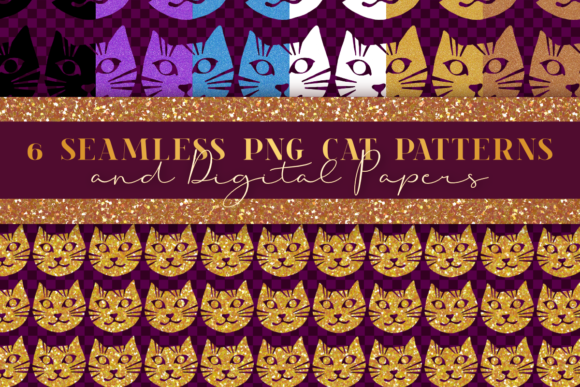
The collection includes six unique patterns — four glitter variants (gold, rose gold, aqua, lilac), plus plain black and plain white. Each functions as both a visual tone-setter and a practical tool:
- Gold glitter cat pattern: Adds warmth and celebratory energy — ideal for anniversary invitations, boutique packaging, or spring festival signage where richness and elegance coexist.
- Rose gold glitter cat pattern: Bridges modern femininity and soft sophistication — frequently used in baby shower décor, feminine wellness branding, and handmade soap labels.
- Aqua glitter cat pattern: Evokes freshness and playfulness — commonly layered behind summer camp newsletters, aquatic-themed children’s books, or eco-friendly product tags.
- Lilac glitter cat pattern: Offers gentle contrast without overwhelming — preferred for sensory-friendly classroom materials, therapeutic activity sheets, and subtle UI accents in mental health apps.
- Plain black cat pattern: Delivers bold graphic impact — leveraged in streetwear graphics, podcast cover art, and high-contrast accessibility-compliant printouts.
- Plain white cat pattern: Provides delicate texture under light overlays — essential for wedding stationery, luxury skincare branding, and translucent vinyl decals.
This intentional variety eliminates the need to manipulate saturation or hue manually — a time-saving factor especially valuable for freelancers managing multiple clients or teachers preparing differentiated learning materials.
Real-World Implementation Across Industries
What makes Funny Glitter Cat PNG Overlay Patterns particularly resilient across sectors is their dual nature: they’re emotionally resonant *and* technically agnostic. Consider how a single pattern might evolve across domains:
In education, a first-grade teacher uses the aqua glitter cat tile as a repeating background for printable reward charts. The shimmer catches children’s attention without visual clutter, supporting focus while reinforcing positive behavior. Meanwhile, a university design instructor assigns the same file in a typography lab — students overlay it beneath serif headlines to explore contrast, hierarchy, and texture interaction in editorial layouts.
In small business operations, a local pet bakery applies the rose gold variant to cupcake wrappers and Instagram story templates. Customers instantly recognize the brand’s playful yet polished identity — and because the file is transparent and high-res, the same asset scales cleanly from a 2-inch sticker to a 48-inch storefront window decal. No redesigns. No vendor delays.
In digital publishing, indie authors creating children’s activity books rely on the plain black and white patterns for consistent page borders and section dividers. The 4096×3074 px digital paper size ensures full bleed coverage on standard US letter and A4 formats, eliminating awkward margins or cropped edges during KDP upload — a frequent pain point for self-publishers unfamiliar with print-safe zones.
Technical Compatibility and Workflow Integration
All files are delivered as PNGs — a universally supported format that preserves transparency and handles complex alpha channels reliably. They open natively in Adobe Creative Cloud apps, Affinity Suite, GIMP, Canva Pro, and even browser-based editors like Photopea. For users integrating into automated systems — such as print-on-demand platforms or e-commerce site builders — the consistent naming convention (e.g., “glitter_cat_gold_tile.png”, “glitter_cat_gold_paper.png”) simplifies batch uploads and metadata tagging. Designers report reduced setup time when building libraries in Figma or Sketch, since the uniform dimensions allow drag-and-drop alignment across frames without manual resizing.
Notably, the absence of embedded copyright watermarks or usage restrictions supports ethical reuse within permitted licenses. Educators may distribute printed versions to students; makers may include the patterns in physical craft kits; developers may embed them in client websites — all without legal ambiguity, provided attribution guidelines are followed.
Seasonal and Contextual Versatility Beyond Obvious Use Cases
While marketed for spring and summer decor — and rightly so, given the lightness and vibrancy of the glitter tones — these patterns demonstrate surprising adaptability year-round. During autumn, the gold variant pairs elegantly with burnt orange and deep burgundy in harvest-themed greeting cards. In winter, the plain white cat pattern gains new life as a subtle snow-dusted texture beneath holiday typography. Even in professional settings, the black and white options serve as refined alternatives to sterile geometric repeats in corporate presentations or nonprofit annual reports — adding warmth and approachability without sacrificing polish.
This contextual elasticity stems from the underlying design philosophy: each cat face is stylized but not cartoonish; each glitter effect is pronounced but not chaotic. There’s intention in the spacing, restraint in the detail, and clarity in the silhouette — qualities that prevent visual fatigue during extended use and support long-term brand cohesion.
Considerations for Optimal Results
To maximize value, users should keep three practical considerations in mind. First, when applying patterns to photographs or busy backgrounds, reduce opacity slightly (to 15–30%) — the transparency already provides blending headroom, and subtlety often enhances legibility. Second, for large-format printing, verify that your RIP (raster image processor) supports 300 DPI PNGs at native size; some older systems benefit from pre-flattening layers in Photoshop before export. Third, when using in web environments, generate WebP or AVIF derivatives for faster loading — the original PNGs remain essential for editing fidelity, but compressed versions improve Core Web Vitals scores without perceptible quality loss.
Finally, remember that pattern effectiveness hinges less on novelty and more on consistency. Using one or two patterns across touchpoints — email headers, social banners, product tags — builds recognition faster than rotating through many. The Funny Glitter Cat PNG Overlay Patterns collection supports that strategy by offering enough variation to avoid repetition fatigue, yet enough coherence in line weight, proportion, and rhythm to feel unmistakably unified.
Conclusion: Where Craft Meets Confidence
At its core, this collection represents more than decorative flair — it embodies confidence in execution. Whether you’re hand-lettering a baby announcement, prototyping a textile line, designing inclusive classroom visuals, or launching a pet-themed subscription box, having access to production-ready, emotionally intelligent patterns removes friction from the creative process. The glitter isn’t just sparkle; it’s signal — a cue that care was taken at every stage, from illustration to encoding. And because each pattern works equally well in analog and digital spaces, across age groups and industries, its relevance endures beyond seasonal trends. That durability — rooted in resolution, transparency, and thoughtful color theory — is what transforms a simple download into a long-term creative asset.