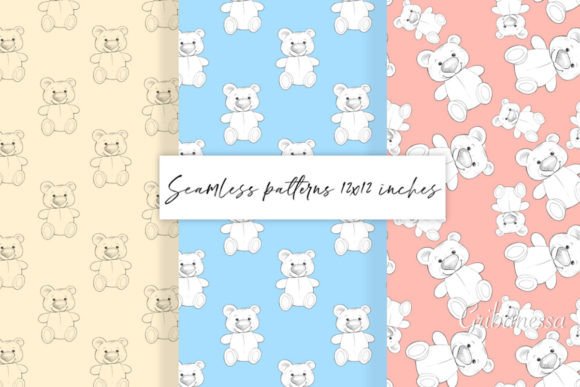
Patterns with Teddy
If you're sourcing digital patterns for creative projects—whether you're designing greeting cards, printing fabric swatches, assembling scrapbook layouts, or producing wall art—you’ve likely encountered Patterns with Teddy. These aren’t just playful motifs; they’re high-fidelity, versatile design assets built for real-world application. Each set includes three JPG files—3600×3600 pixels, 300 dpi resolution—optimized for clarity at print scale and flexibility across media. That means crisp repeats on invitation suites, clean transfers to textile mockups, and sharp detail when scaled down for gift tags or up for gallery-wrapped canvases.
Why “Just a Pattern” Isn’t Enough
Many creators assume that any repeating teddy bear motif will do—especially if it’s free or low-cost. But resolution, color integrity, and repeat logic matter more than charm alone. A pattern downloaded from an unverified source may look fine on screen but pixelate when printed at 8×10 inches—or worse, tile with visible seams that ruin the illusion of continuity. Others overlook metadata: no embedded ICC profile, inconsistent CMYK/RGB handling, or compressed JPEG artifacts can shift tones unpredictably across devices and printers. That subtle warm beige in your mockup might become a muddy tan on press—costing time, paper, and client trust.
1. Assuming “High Resolution” Means “Print-Ready”
“3600×3600 px” sounds impressive—until you realize it’s only useful if the pattern is designed with seamless tiling in mind. Some designers stretch or crop repeats to hit pixel dimensions, creating misaligned edges or distorted proportions. With Patterns with Teddy, each file is built as a true seamless repeat: the top edge matches the bottom, left aligns with right, and scaling preserves balance. Before downloading, check whether the preview shows a tiled grid—not just a single frame. If the vendor doesn’t provide a zoomable demo or tile test image, ask. Reputable creators (like Gribanessa) include this in their previews precisely because it prevents wasted prints.
2. Ignoring Use-Case Constraints
A pattern perfect for scrapbooking may fall short for fabric printing. Why? Because paper crafts tolerate minor alignment quirks; woven textiles demand precise, bleed-free repeats with consistent thread count simulation. Likewise, wall art benefits from generous negative space around motifs to avoid visual clutter at large scale—while gift wrap needs tighter spacing for rhythm and coverage. When evaluating Patterns with Teddy, match the pattern density and motif size to your end medium. For example: use the softer, airier variants for handmade cards and journals; choose bolder, higher-contrast versions for fabric or signage where legibility matters at distance.
3. Skipping the “Test Print” Step
It’s tempting to jump straight into production—especially when deadlines loom. But skipping a small-scale test print is how good projects become inconsistent ones. Inkjet vs. laser, matte vs. glossy stock, even ambient lighting changes how warmth and contrast read. Print one 4×4 inch swatch first. Hold it under the same light you’ll use for final presentation. Does the teddy’s fur texture stay soft? Do background gradients hold smoothness? If colors shift or edges blur, revisit your export settings: ensure your editing software isn’t applying unintended sharpening or color conversion. Gribanessa’s files are pre-optimized for Adobe RGB (1998) and sRGB—so keep color management turned on and “preserve embedded profiles” selected.
What to Verify Before You Download or Buy
- File format & naming: Confirm you’re receiving JPGs—not PNGs masquerading as JPGs with transparency layers that won’t print correctly. Look for clear naming like teddy-repeat-01.jpg, not generic labels like image123.jpg.
- Repeat type: Seamless? Half-drop? Brick? Seamless is safest for beginners; half-drop adds visual interest for advanced layouts—but only if your design software supports proper offset tiling.
- Licensing scope: Gribanessa’s Patterns with Teddy are licensed for both personal and commercial use—including physical products like stationery, apparel, and home goods. But resale of the raw files or claiming authorship is prohibited. Always review the license summary before checkout—even if it’s a “personal use only” listing elsewhere.
- Color mode consistency: All three files should be in the same color space. Mixed RGB and CMYK files in one pack cause mismatches in layered documents. Gribanessa delivers all in RGB—ideal for screen-based work and most consumer printers—and notes if CMYK variants are available upon request.
Better Workflow Habits for Long-Term Use
Treat your pattern library like a toolkit—not a one-time purchase. Organize downloads by repeat type, motif density, and dominant hue. Tag files with keywords like scrapbooking, gift-wrap, or textile-ready so you can filter fast when inspiration strikes. And don’t hoard: if a pattern doesn’t serve at least two distinct project types within three months, reassess its value. Gribanessa’s sets shine because they’re intentionally cross-functional—designed to move fluidly between paper, fabric, and digital output without rework.
Finally, remember that quality patterns save time far beyond the download. A well-built Patterns with Teddy file eliminates hours spent manually adjusting tiles, correcting color casts, or reprinting due to seam errors. That’s not just convenience—it’s professional reliability. Whether you’re a teacher prepping classroom decorations, a freelancer building a client’s brand kit, or a small-batch maker launching seasonal packaging, choosing assets that behave predictably lets you focus on storytelling, not troubleshooting.
Thank you—and good luck in your work. Gribanessa.