Minimalist Christmas Seamless Patterns
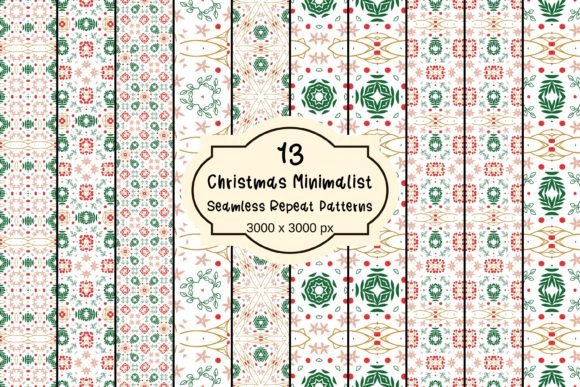
Minimalist Christmas seamless patterns offer clean, intentional holiday design—stripped of clutter but rich in warmth and quiet celebration. Think subtle pine sprigs, delicate geometric trees, or understated red-and-green repeats that breathe space into your projects instead of overwhelming them. These aren’t just “less busy” versions of traditional prints—they’re thoughtfully composed for versatility, scalability, and visual harmony across surfaces. Whether you're designing eco-friendly gift wrap for a small batch of artisan soaps, printing fabric for a capsule holiday collection, or building a cohesive brand aesthetic for a seasonal email campaign, minimalist seamless patterns help you communicate sophistication without shouting.
Why creators choose these 13 patterns—and why size matters more than you think
This set includes 13 high-resolution JPEG files, each 3000 × 3000 pixels at 300 DPI. That resolution isn’t arbitrary: it ensures crisp output whether you’re scaling up to a 24-inch canvas tote bag or shrinking down to a 2-inch gift tag. Many designers assume “seamless” means “ready for any use”—but that’s only true if the file is large enough *and* built with true repeat logic. Some free or low-cost pattern downloads are merely cropped sections of larger artwork—not mathematically tiled—so they misalign when repeated in design software. Others max out at 1200 × 1200 pixels, which looks soft on printed textiles or large-format packaging. These 13 patterns avoid both pitfalls: each is genuinely seamless (tested across Adobe Illustrator, Affinity Designer, and Procreate) and sized to retain fidelity at real-world production scales.
A common oversight: assuming color palette = usability
Yes, the set uses classic red and green—but not as saturated, festive primaries. Instead, tones are softened: sage over forest green, terracotta-leaning reds, charcoal accents, and plenty of breathable white or off-white space. That restraint is intentional. If you’re printing on natural cotton fabric or kraft paper, overly bright RGB reds won’t translate cleanly—you’ll get muddy results or unexpected color shifts. These patterns were designed with CMYK-ready values in mind, and the muted palette adapts gracefully to spot-color printing, foil stamping, or even embroidery digitizing. Before downloading or purchasing any minimalist Christmas seamless patterns, check whether the seller provides color mode guidance (RGB vs. CMYK), embedded ICC profiles, or Pantone references. If not, ask. It saves time—and reprints—later.
Mistake #1: Using patterns without checking scale consistency
Not all “3000 × 3000” files repeat at the same visual scale. One pattern might feature a single tiny star every 2 inches; another could place a full Christmas tree motif across the entire tile. Without previewing how the repeat behaves at actual size, you risk mismatched proportions—say, pairing a fine-lined wreath pattern with a bold tree print on the same product line. That inconsistency weakens branding and confuses customers. A better approach? Open one pattern in your design app, apply it to a rectangle matching your final output dimensions (e.g., 12″ × 18″ for wrapping paper), then zoom to 100% view. Does the motif feel balanced—not lost, not overpowering? Repeat that check across three patterns before committing to a full set.
Mistake #2: Forgetting licensing scope—and where you actually need it
These 13 minimalist Christmas seamless patterns come with broad commercial rights: use them on mugs, T-shirts, tote bags, websites, greeting cards, and more. But “commercial use” doesn’t automatically mean “unlimited distribution.” If you’re creating a digital product—like a Canva template pack or a printable planner—you’ll need extended licensing (which this set does not include). Similarly, embedding patterns directly into an app UI or SaaS platform background requires separate permission. Always read the license summary *before* integrating into client work or scalable products. When in doubt, treat the files like physical materials: you can print them on goods you sell, but you can’t resell the pattern files themselves or claim authorship.
What to verify before downloading or buying
- File format: JPEGs are great for quick mockups and web use—but if you plan to recolor motifs in vector software, confirm whether PNGs with transparent backgrounds or vector/SVG versions are available (they’re not in this set, so adjust expectations).
- Repeat integrity: Look for a small animated GIF or tiled preview showing the edge alignment. If only static thumbnails exist, request a test tile from the seller.
- Design intent: Are motifs abstract or literal? This set includes both—subtle dots alongside recognizable trees and gifts—so scan thumbnails to ensure stylistic alignment with your project (e.g., a kindergarten teacher crafting holiday cards may prefer friendlier shapes than a luxury skincare brand).
- Compatibility notes: Some seamless patterns behave unpredictably in older versions of Photoshop or free tools like GIMP. Check if the seller notes known software limitations.
Real-world applications—and what works best where
Because these patterns are truly seamless and high-res, they perform well where others falter. For fabric printing, the consistent 3000 × 3000 grid aligns cleanly with standard textile repeat requirements—no manual tiling needed. For website backgrounds, the resolution allows responsive cropping: use the center 1920 × 1080 section for desktop, a 750 × 1334 crop for mobile hero banners. On ceramic mugs, the even density prevents motif distortion near the handle curve. And for gift tags or stickers? Print one tile at actual size—no resizing required—and cut precisely. That reliability cuts prep time by 30–50% compared to stitching together lower-res assets.
A note on sustainability—and why minimalism supports it
Minimalist Christmas seamless patterns support thoughtful production. Less ink coverage means lower material costs and reduced environmental impact—especially important if you’re screen-printing organic cotton tees or using soy-based inks on recycled paper. The restrained palette also translates well to unbleached fabrics and natural kraft board, eliminating the need for heavy underbases or opaque inks. That’s not just practical—it resonates with buyers who value intentionality in both design and ethics.
Final tip: Start small, test often
Don’t try all 13 patterns at once. Pick two—one with botanical hints (like simplified holly or pine) and one with structural elements (geometric trees or gift boxes)—and apply them side-by-side to the same product mockup. Compare how they look printed, on screen, and in natural light. Notice which feels more aligned with your voice, audience, and production method. That kind of deliberate testing builds confidence faster than browsing thumbnails ever will—and helps you invest wisely in future pattern sets.