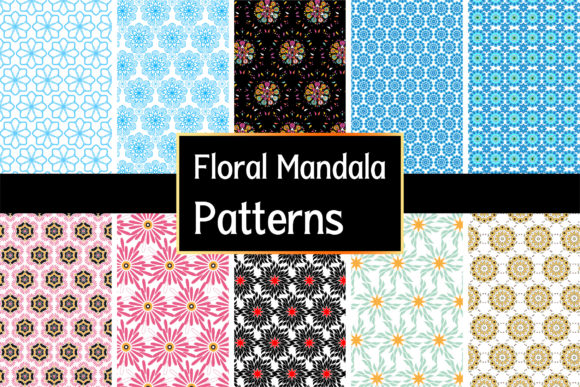
Mandala Patterns Design Decorative: A Practical Guide for Designers and Creators
Mandala Patterns Design Decorative refers to a curated set of digital design assets rooted in the symmetrical, radial geometry characteristic of traditional mandalas—but adapted intentionally for modern decorative applications. Unlike hand-drawn spiritual diagrams or generative art tools, this collection delivers production-ready files optimized for versatility across physical and digital outputs. Its value lies not in abstraction alone, but in functional precision: each pattern is built on a consistent 1920px × 1280px canvas, with intentional spacing, clean vector paths, and layered transparency—making it suitable for both screen-based interfaces and scalable print workflows.
What Sets This Mandala Patterns Design Decorative Collection Apart
Not all mandala-themed design resources serve the same purpose. Some are high-resolution photographic textures; others are algorithmically generated SVGs with unpredictable layering or inconsistent stroke weights. This Mandala Patterns Design Decorative set distinguishes itself through format diversity and intentional editability. It includes six distinct file types—AI, EPS, SVG, DXF, JPG, and PNG—each serving a specific technical need:
- AI and EPS files preserve full vector fidelity and editable layers, ideal for professional designers using Adobe Illustrator who need to adjust colors, scale infinitely, or extract individual motifs.
- SVG files support responsive web use, animation, and integration into CMS platforms or no-code builders—without relying on raster fallbacks.
- DXF files enable direct import into CNC routers, laser cutters, and CAD software, bridging digital design with physical fabrication like wood inlays, metal etching, or vinyl cutting.
- JPG and PNG files offer immediate usability: the JPG provides broad compatibility for presentations or mockups, while the PNG includes alpha transparency for seamless overlays on varied backgrounds.
This breadth avoids forcing users into workarounds—such as converting low-res images to vectors or manually redrawing outlines from raster sources. The consistency of canvas size also simplifies batch processing, alignment across projects, and responsive layout testing.
How It Compares With Other Approaches to Mandala-Inspired Design
Designers evaluating options often weigh Mandala Patterns Design Decorative against alternatives like royalty-free stock libraries, generative design plugins, or custom illustration commissions. Each has tradeoffs:
Stock libraries (e.g., Shutterstock or Freepik) offer volume but rarely guarantee uniform technical specs. A search for “mandala pattern” may return 500+ results—but only a fraction will include SVG + DXF + AI in one package, and fewer still maintain clean anchor points suitable for cutting machines. Users frequently spend hours filtering, reformatting, or troubleshooting embedded fonts or rasterized elements.
Generative tools—like those built into Figma plugins or Processing sketches—offer customization but require technical familiarity. Adjusting symmetry parameters, exporting at precise dimensions, or ensuring path compatibility with manufacturing software adds overhead. For someone needing a reliable, off-the-shelf solution for a client deadline or small-batch product line, that learning curve may not align with project constraints.
Custom illustration, while offering full uniqueness, introduces cost, timeline uncertainty, and revision cycles. Mandala Patterns Design Decorative occupies a middle ground: professionally crafted, yet immediately deployable. It’s not bespoke—but it avoids the unpredictability of crowdsourced assets or the friction of building from scratch.
When This Collection Fits Best
Mandala Patterns Design Decorative suits situations where clarity, consistency, and cross-platform readiness matter more than absolute novelty. Consider it when:
- You’re developing a wellness brand identity and need repeatable, calming motifs for packaging, web headers, and social templates—without licensing ambiguity.
- You’re prototyping home décor items (e.g., ceramic tiles, textile prints, or wall decals) and require files that translate accurately from screen to print to physical cutting tools.
- Your team uses mixed software—some members rely on Affinity Designer, others on Inkscape or Silhouette Studio—and you need formats that retain integrity across ecosystems.
- You’re creating educational materials (e.g., mindfulness worksheets or classroom posters) and need scalable graphics that remain legible when resized for projection or handouts.
In these cases, the inclusion of both vector and raster variants reduces dependency on single applications or conversion steps—saving time without compromising quality.
Limitations to Acknowledge
No resource covers every use case. Mandala Patterns Design Decorative is intentionally standardized—not adaptive. It does not include animated versions, multi-color variants, or alternate aspect ratios. If your project demands dynamic color shifts based on user interaction (e.g., hover effects in web UI), you’ll need to extend the SVG manually. Similarly, if you require patterns tailored to specific cultural symbolism or regional stylistic conventions—beyond general geometric harmony—the set offers aesthetic cohesion rather than ethnographic specificity.
Also, while the DXF file supports fabrication, it assumes basic familiarity with toolpath setup. Users new to laser cutting may still need to adjust power/speed settings or verify kerf compensation separately—the file enables the workflow but doesn’t automate machine calibration.
Making a Practical Decision
Choosing whether Mandala Patterns Design Decorative fits your needs comes down to three questions:
- Do you prioritize reliability over experimentation? If you’ve experienced delays from incompatible downloads or broken vector paths, the tested interoperability across AI, EPS, SVG, and DXF becomes a measurable advantage.
- Is your output medium diverse? If your work spans digital screens, printed collateral, and physical products, having one source asset that exports cleanly to each environment reduces version control issues and visual inconsistency.
- Do you have constraints around time, budget, or technical bandwidth? When hiring an illustrator isn’t feasible and coding a generator feels excessive, a thoughtfully packaged set strikes a practical balance.
That said, it’s not the optimal choice if you need photorealistic textures, hand-painted imperfections, or deeply narrative compositions. For those ends, curated texture packs or commissioned artwork remain stronger options. Likewise, educators building open educational resources might prefer CC0-licensed alternatives—even if they require more formatting—depending on redistribution policies.
Ultimately, Mandala Patterns Design Decorative serves as a foundational element—not a finished solution. Its strength is in enabling next steps: adapting a motif for embroidery digitizing, repurposing a segment as a logo lockup, or layering multiple patterns for depth in a branding system. That utility emerges not from complexity, but from thoughtful standardization.
Whether you’re refining a boutique product line, supporting a community arts initiative, or iterating on a personal creative practice, the right pattern resource supports your process—not interrupts it. Mandala Patterns Design Decorative reflects that principle: designed to integrate, not dominate.