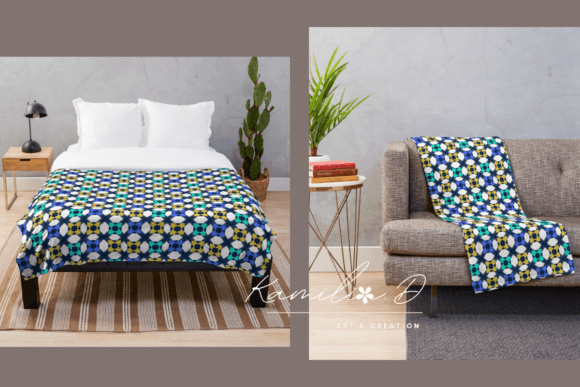
Algerian Zellige Patterns: Authentic Tile Motifs for Modern Design Projects
Algerian Zellige Patterns aren’t just decorative—they’re cultural artifacts encoded in geometry, color, and centuries of craftsmanship. Originating from the Maghreb region and refined over generations in cities like Tlemcen, Algiers, and Constantine, these intricate tilework motifs carry deep symbolic meaning while offering unmatched visual versatility. Today, designers, architects, and digital creators are turning to high-fidelity Algerian Zellige Patterns—not as static images, but as flexible, production-ready assets that bridge heritage and contemporary workflows.
What Makes Algerian Zellige Patterns Distinct?
Unlike generic Islamic geometric patterns, authentic Algerian Zellige Patterns reflect regional variations in proportion, symmetry, and palette. The zellige dziri, for example, often features tightly interlocked eight-pointed stars with subtle tonal shifts in cobalt, emerald, and ivory—traditionally hand-cut and glazed in workshops across western Algeria. Meanwhile, zellige bni ziri (named after the historic Bni Ziri dynasty) leans into bolder, more rhythmic repetition—ideal for large-scale wall treatments or textile repeats. And zellige DZ - Machouar Telemcen draws directly from the famed 13th-century Machouar Palace in Tlemcen, where artisans fused Andalusian precision with local Berber sensibilities. Its hallmark? A central medallion flanked by alternating bands of hexagonal and lozenge-based tessellations—complex, balanced, and unmistakably Algerian.
These aren’t stylized abstractions. Each pattern encodes lineage—through line weight, tile spacing, and even the slight irregularities that speak to handcrafted origins. That authenticity matters when you’re building brand identity, designing immersive spaces, or creating culturally grounded visuals.
Why High-Quality Digital Assets Matter
Low-res JPEGs or poorly vectorized SVGs flatten the nuance of Algerian Zellige Patterns. They blur fine lines, mute intentional color gradients, and break seamless tiling—especially at print scale or on retina displays. That’s why the latest release focuses on production-grade fidelity: PNG files with transparent backgrounds, crisp up to 6000×6000 px, plus scalable PDF versions optimized for both screen and offset printing.
Each file is carefully cleaned and aligned—no stray pixels, no unintended shadows, no compression artifacts. The transparency ensures effortless layering over photos, gradients, or textured backdrops in Photoshop, Figma, or Adobe XD. Whether you’re mocking up ceramic tiles for a boutique hotel lobby, overlaying a pattern onto packaging foil, or animating a subtle background loop for a cultural documentary website—the clean alpha channel gives you full control.
Three Ready-to-Use Designs—Curated for Real Workflows
This collection includes three distinct Algerian Zellige Patterns, each selected for broad applicability and stylistic integrity:
- Machouar Telemcen Core — A symmetrical, medallion-driven layout ideal for focal points: website hero sections, invitation centerpieces, or framed wall art mockups. Its radial balance creates instant visual hierarchy.
- Dziri Linear Repeat — A horizontal stripe variant derived from traditional zellige dziri, optimized for seamless tiling. Perfect for borders, UI dividers, fabric swatches, or wrapping around 3D product models (think ceramic mugs or artisanal soap boxes).
- Bni Ziri Grid — A modular, tile-based repeat built from interlocking hexagons and triangles. Highly adaptable for floor plan overlays, architectural renderings, or generative design experiments in Processing or p5.js.
All three are delivered in a single ZIP archive—no paywalls, no attribution requirements, no hidden watermarks. Just immediate access to culturally grounded, technically precise Algerian Zellige Patterns, ready for commercial or personal use.
How Designers Are Using These Patterns Right Now
In practice, these assets go far beyond “pretty backgrounds.” A branding studio in Casablanca recently used the Machouar Telemcen Core pattern as the basis for a luxury olive oil label—scaling it down to a 12 mm repeat on matte kraft paper, then spot-varnishing key star points for tactile contrast. In Berlin, an interior designer applied the Dziri Linear Repeat as a vinyl decal along a staircase riser, syncing its rhythm with the step count to create a subtle, kinetic effect.
Even digital-first teams benefit. A SaaS company launching a North African fintech platform embedded the Bni Ziri Grid as a subtle CSS background on dashboard cards—using background-size: 80px and opacity: 0.07 to suggest depth without distraction. The result? A quiet nod to regional identity that users subconsciously associate with trust and craftsmanship.
Choosing the Right Pattern for Your Project
Not every Algerian Zellige Pattern suits every context. Ask yourself:
- What’s the scale? Large surfaces (façades, trade show booths) favor bold, low-frequency repeats like Bni Ziri Grid. Small interfaces (app icons, email headers) respond better to tighter, higher-contrast motifs like Machouar Telemcen Core at reduced opacity.
- What’s the medium? For physical products (ceramics, textiles), prioritize the high-res PNGs—they preserve edge sharpness critical for laser cutting or screen printing. For web animations or responsive layouts, the PDF vector version allows smooth scaling without pixelation.
- What’s the emotional tone? Zellige dziri feels serene and contemplative; zellige bni ziri reads as confident and rhythmic; Machouar Telemcen conveys gravitas and legacy. Let your project’s voice guide the choice—not just aesthetics.
Also consider color flexibility. Because all PNGs ship with transparency, you can easily recolor them non-destructively using blending modes (Color Burn, Hue, or Overlay) in Photoshop—or via CSS filter: hue-rotate() for web. That means one asset can serve multiple brand variants without re-exporting.
Technical Notes You’ll Appreciate
Each file was generated from meticulously traced historical references—not AI-generated approximations. The grid alignment follows traditional qasr (measuring rod) ratios used by master maâlems in Tlemcen. Colors were calibrated against pigment swatches from restored 15th-century madrasas—so what you see is historically informed, not algorithmically guessed.
The ZIP contains:
- 3× PNG files (6000×6000 px, RGB, transparent background, sRGB IEC61966-2.1)
- 3× PDF files (vector-based, CMYK + Pantone-ready, embedded fonts disabled for universal compatibility)
- A lightweight README.txt with usage tips, licensing clarity (CC0—free for commercial & personal use), and historical footnotes
No plugins. No subscriptions. No login walls. Just direct, respectful access to Algerian Zellige Patterns—preserved, optimized, and made useful.
Where Algerian Zellige Patterns Fit in Today’s Creative Ecosystem
In an age of mass-produced visuals and algorithmic homogenization, Algerian Zellige Patterns offer something rare: depth with discipline. They’re not “trendy”—they’re enduring. Their mathematical rigor satisfies UX designers who value consistency; their cultural resonance speaks to marketers building authentic connections; and their visual richness inspires illustrators, typographers, and motion designers looking for structure with soul.
More than decoration, they’re a language—one that communicates patience, precision, and place. When you choose an authentic zellige dziri motif over a generic geometric filler, you’re not just selecting a pattern. You’re aligning your work with a living tradition—one that continues to evolve, not as nostalgia, but as relevance.
So whether you're drafting a tile specification for a new riad renovation in Algiers, building a Shopify theme for a handmade ceramics brand, or prototyping AR filters that overlay heritage motifs onto cityscapes—these Algerian Zellige Patterns are built to perform. Accurately. Beautifully. Meaningfully.